Tag: Silk thread
Both Edges Reached, and beginning to fill in a gap…

Both Edges Reached
I’ve become rather obsessed with making progress on the Christus Natus Est panel. Now that the spiral is finished, and the gold couching only stretches from edge to edge, that progress becomes easier to see.
In particular, not only have I managed to finish the top of St Joseph’s head, and run two or three more rows across the bottom of the panel, but I’ve started to fill in the gap between the spiral and the breakaway line. In fact I’m not sure that I am entirely happy with it – I may have begun to use single threads on both sides of the triangular shape a little early, which leaves some gaps in the coverage.
I will have a lot of tidying up and corrective stitching to do, even when the whole fabric is covered with gold. I need to finish the Christ Child’s halo, and put St Joseph’s in place. I also need to correct the curve of the Virgin’s gown, which is a little flat and straight.
I don’t yet know whether I will stitch rays coming from the star. I think that decision will be made only when the rest of the piece is finished.
I’m beginning to think about the mounting and framing of this piece. I think it will need a wide mount, because such a vibrant piece will need plenty of air between itself and the frame. One possiblity involves a mount covered in cloth of gold or gauze, and trimmed with braid or crystals. If I can’t find a suitable fabric, I will have to hope for a mount card in the right shade of gold. A cream mount would look insipid, and a mount in one of the colours would contend for attention with the panel itself. It’s just as well we have a good framing shop nearby!
Still More Progress
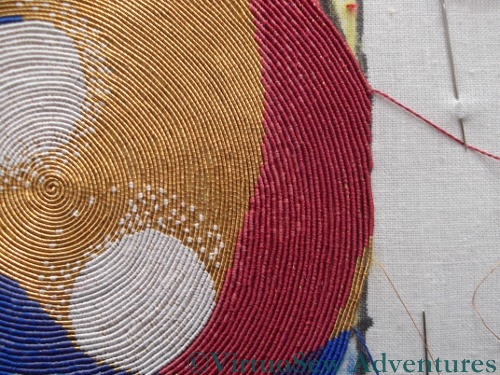
Close-up of the right-hand edge
I’ve been making more progress, and in fact passed another milestone this past week.
I’ve reached the right-hand edge and started to stitch just on the top section for a while. Suddenly it feels quicker, because although I’m making progress at the same rate as before (the stitching itself hasn’t speeded up!) I sometimes manage two or more rows in a session, and the sections of design that are covered are side-by-side, and thus more noticeable.

A View Of The Whole
So here is the whole thing to show the progress that I’ve made. I’ve unpicked and removed the line of gold I put in following the black line, because in fact it isn’t running exactly where I want it to, even if it is running along the line I drew.
I sink the threads in batches at the end of a session, which means they don’t slow me down when I’m nicely “in flow”, but it looks neat and easy to understand when I get back to it. When I’ve reached the black line (the correct one!) I shall stop working on the top section and work on the bottom section until that is done, then I will have the last section to work which should go more speedily as there will only be one colour to stitch.
I’m beginning to have hopes of finishing this in time to use it as a Christmas card. Now I just need to work out how to frame it…!
More on the Elephant of Infinite Charm

Trial of Interlacing
You may recall that last week I said I was thinking of working one of the new interlacing patterns on the Elephant’s saddlecloth. I ferreted around in my box of metallic threads and found several golds and coppers to choose from. Finally I chose a warm copper, and looked up the instructions for the interlacing.
I really didn’t like the look of it at all. Somehow it looked tangled and rather moth-eaten, instead of exotic. Not A Good Look, so out it came.

Final Decision
So in the end I decided to use ordinary trellis couching. The couching stitches are upright cross stitches in the copper thread, over a silk foundation. It looks a little dull in the photo, but in real life the little sparkle of copper “lifts” it nicely, and I think it will work well.
You might also notice that I’ve finished outlining him, using the thread that shades from brown to cream. It means that his edges aren’t always emphasised to the same degree, which I think is a good thing.
Artists talk of “light and shade”, and we usually interpret that as meaning simply that the patterns of tone are what build up a recognisable image. To an extent that is correct, in that if the tones are wrong, a picture won’t work well. When we are talking of a design of lines rather than shapes, however, it’s less obvious what we mean. I am trying to create a pattern of varying densities of stitching as well as colour, and in the end what I hope to have achieved is a pleasing rhythm for the eye to follow, not “sticking” anywhere, but not frantically jolting from one part of the design to the next.
Tricky!
Another Landmark on Christus Natus Est

Another Landmark on Christus Natus Est
I’ve got to the point where the lower ends of the robes of Mary and Joseph have both been started, which also brings me very close to the other edge of the panel.
It’s been a little slow of late, partly because the weather has been frightful – grey and overcast. Stitching goldwork in bright sunshine is a recipe for eye fatigue (learn from my mistakes, Gentle Reader!) but at the same time the rich red of Joseph’s robe and the purple of the Christ Child both become quite difficult as the day turns darker. I’m finding that if I want to make progress, everything else has to come second to doing a row or two when the light is good. Sometimes I’m so busy doing other things that I only realise quite late that I’ve missed the best of the light. Very frustrating!
The other reason it has been slow is that I have so many needles in operation – ten of them! Every change of colour means putting one needle aside and picking up another, and while this is a tangible demonstration of progress, and therefore welcome, it does rather slow me down!
I’ve been talking recently with a friend who has been trained in icon painting, and it’s fascinating to hear about the layers of meaning and symbolism in the materials, preparations and even in the process. I’m working so hard on developing a technique here, that I’m not necessarily managing to turn my version into a spiritual exercise as well, although I do sometimes feel that I’m not a million miles away from stitching-as-meditation.
Well, St Benedict said “Laborare est orare” (“To work is to pray”). So maybe I’m onto something, after all.
One Collared Elephant
You can tell that the Elephant’s inspiration was the right one – suddenly he’s taken off!

The Elephant Collared
I’m using one set of variegated silk thread (shading from orange to brown) for the harness and headcloth and saddlecloth, and another (shading from cream to brown) for any small bits of the Elephant that show through all his finery. I shall have to redraw his head and headcloth – the transfer has rubbed off – but I’m pretty pleased with progress.
The collar is worked in six rows of braid stitch, which is a stitch that always looks better in a round yarn like this silk perlé. The roundels hanging from the collar are two rows of buttonhole stitch, and the roundels on the ear-covering are spiral trellis stitch – at the moment. I’m not quite sure that they are right. I first used Spiral Trellis on the Jacobean Work Panel, and really enjoyed stitching it, but I think these look too fussy. One big one might be better, and it would allow the colour change in the thread to show a little more.
I’m glad that I have worked out something to do next, as his anklets are giving me trouble.They are smooth and domed in the original model, but I think satin stitch might look a little ordinary.
I’ve used small satin stitches to outline the border of the saddlecloth, but only because I wanted something quiet to contain the excitement I intend to put inside it – I’m planning to use one of the complicated interlacings from the Tudor and Stuart Goldwork Masterclass for the saddlecloth, but extended to form an all-over pattern.
Watch this space…!
Rethinking The Elephant Doorstop

Needs More Thought
I originally decided to use plain stranded cotton for the Elephant Doorstop, in colours chosen to match the curtains in the living room as closely as possible.
However, once I started stitching I rapidly came to the conclusion that that just wasn’t going to work. We don’t want the Elephant to cover all my careful stencilling, but at the same time, he needs to show up. And he looks pretty hidden, here, as you can see. What’s more, I wasn’t enjoying it, and picking stitches was proving troublesome. I knew I wanted to stitch him – revisiting the original inspiration has been in the back of my mind for a while – but somehow, not like this.
There are two things I need to think about – the colours, and the weight of the thread. The creamy colours we chose are too light to show up well against the rather busy stencilled background, and although two threads of stranded cotton would be fine on this fabric, if it were a plain fabric, it is rather fine. Furthermore, one of the stitches I want to use is braid stitch, which is always a bit tricky in stranded cotton.
I’d already unpicked this section twice before I came to this conclusion, and I was beginning to feel rather anxious in case inspiration flagged completely. Then out of the blue, I was deafened by some triumphant trumpetings.
“I know what to do, I do!”, said he.
“What, then?” said I.
“Use some of those variegated silk perlés you’re always looking at. You can do any stitch that takes your fancy, the colours shading in and out will give you the lightness of effect you want, and – Ta-DA!”.
So now I’ve been told….!
Tudor and Stuart Goldwork Masterclass – Update on the Tudor Pincushion

First Stage Of Border
I’m making reasonably good progress with the Tudor Pincushion which is part of the Tudor and Stuart Goldwork Masterclass. The silkwork was finished a while ago, and now there are several different isolated stitches, and a continuous border.

Silver Guilloche Close Up
I’m not using the real metal thread for this. I rather like the rich, vibrant colour of this thread, wrapped around a cotton core, and as I am planning to create a sort of winter “corner decoration” using all of my historical embroidery pieces, there is something positive to be said for the idea of using as many different shades of gold and silver as I can to create a really rich, varied impression.

Border Close Up
The small sections of silver Guilloche Stitch have worked well, although I still have reservations about my gold Spider’s Web stitches, especially when I look at close-up photos of them!
The border is a Guilloche Stitch variation worked on a Ladder Stitch base. As it turned out, I didn’t get quite the right number of rungs on the ladders, so rather than being a neat continuation of the Guilloche Stitch, the corner elements are rather improvisatory.

Tudor Pincushion - Almost Finished
This doesn’t worry me. At the moment, I am still waiting for the instructions for the central ornamental stitch, and if, by the time I have that stitch, I’ve decided that I really must redo it, I will do so then. By that time I will be still more practised at working with metal threads, and it should go more swiftly and easily.
In the meantime, I can go on to play with more new stitches, and even, perhaps, start work on the real metal threads to add them to the Spot Sampler!
Tudor And Stuart Goldwork Masterclass – Month Fourteen

Plaited Braid Stitch In Pearl Cotton
The Plaited Braid Stitch was one of the reasons I wanted to do this course. There are instructions in at least half of my books on embroidery, and I’ve watched Tracy Franklin demonstrate the stitch. I even spent a whole day practising it at one of her courses. Sometimes it worked, sometimes it didn’t, and frustratingly, I never felt I knew what I was getting wrong.
Consequently, when I sat down to tackle this month’s Stitch, I was expecting frustration and fury to reign. I started with Pearl Cotton, thinking that I would be less fretful about errors if I was not conscious of using an expensive thread. I watched the animation first, and although you can see that the first inch of my practising got very tangled up, I’m sure that it helped.

Plaited Braid Stitch In Gold
As I’ve repeatedly mentioned in my posts about this course, I’ve become acutely aware that the question of scale is critical to the success of some of these stitches. My first effort in pearl cotton was at too large a scale, and the thread floats were too floppy. In the case of the second trial, I reduced the size of the stitch, and suddenly found it coming together, which gave me some confidence that I was beginning to understand the structure of the stitch. The tension was still a little slack, but all in all, it was beginning to make sense.
So then I found a piece of scrap linen, and started playing with gold thread. Again the two rows are at slightly different scales, but now I really feel that I am going to master this stitch.
I also think I’ve cracked the problem of why the vast number of books I have on the subject don’t help. With the honourable exception of The Right Handed Embroiderer’s Companion, by Yvette Stanton of White Threads, they all use the same inadequate set of diagrams, presumably copied from an earlier publication. Furthermore, judging by the (slightly differing) diagrams in Tricia’s notes and Yvette’s book, they diagram the left-handed technique. Since all their other diagrams are for right-handers, these books provoke considerable confusion! Still, I now know where to go when I need to be reminded how to do the stitch, and I feel confident that with a bit of practise I will be able to pick it up any time I need to.
And I will need to. I have a few ideas buzzing around in my head, and Plaited Braid Stitch will take its’ place in them!
Tulip Needlework Nibble – Getting Started

Tulip Kit And Finishing Kit
My kit and finishing kit for the Tulip Slip Needlework Nibble arrived very promptly. They have obviously got all this down to a fine art, now, at Thistle Threads, because I was expecting it to be another week at least!
My Tulip Kit contains the linen and silk for the embroidery, while the finishing kit contains silk velvet for the pincushion, gimp to edge the slip, and Grecian Twist to trim the pincushion when it’s finished. The parcel also contained information about the Exhibition being supported.

Tulip Kit - Silks and Chart
I’ve said before that I colour in charts when I’m about to start on counted work. I should have explained that I don’t colour in the whole thing, or at least, not necessarily. The second photo shows the linen and silks lying on my printout of the instructions. You can see that in this case I’ve picked one colour in each section to colour in. Usually it’s best to pick one of the middle tones, because if a design is properly charted, as this one is, the dark colours will have dark symbols, and the light colours, light symbols. The coloured shade is to help make it clear which of the medium-to-light tone of symbols is which.
It is really simply there to help me find my place on the chart just at a glance, without having to take to long to check I’m still doing the right thing!
Sampler Silkwork Finished!

Sampler Silkwork Finished!
At last I have finished the silkwork on the sampler for the Tudor and Stuart Goldwork Masterclass. I don’t have much patience with counted work – I just keep doing it occasionally, as a salutary discipline! – so I am really very pleased with myself. After all, I began stitching it – according to my post on the subject – in June last year!
I’m pleased that I persevered. It’s fascinating to see the Queen Stitches create an entirely different fabric, with a totally different surface and reflectance to the surface of the fabric itself, and the other stitches (Rice Stitch, Roman Stitch and the Bargello section) all reveal different aspects of the silk thread and provided different challenges in working them.
In fact, in the end I have enjoyed the silkwork on the sampler rather more than I expected to. It has taken me much longer than some of the other members of the course, but I’ve been working on the Piano Shawl and the Dreams of Amarna at the same time, so I think I have a good excuse!
Now I need to work out how I am going to keep track of which goldwork stitches to do where. I’ve been printing out the instructions as I go along (thank heavens!) but I now have a large folder full of the historical essays Tricia has written for each month, and another one full of the stitches. It isn’t difficult to have a single chart by my workstand as I stitch, but I think I may need to create an annotated chart for the goldwork. So far, many of the stitches have been familiar enough for me to do some of them with only the name and placement to guide me, but in other cases I know I will need to have the folder open at the instructions as well. One of these days we will have to find a house with a studio for me to work in!